Technical overview
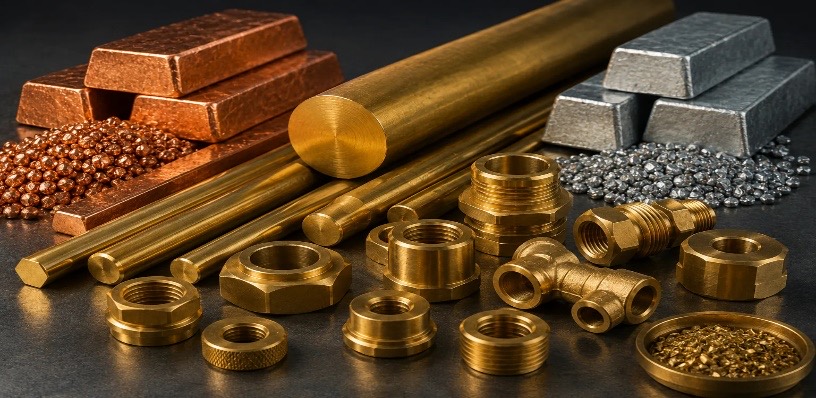
Brass is a family of copper-zinc alloys, not a single material. Free-cutting brass (C36000) adds 2.5–3.0% lead and is the reference alloy against which copper-alloy machinability is rated (rating 100). Cartridge brass (C26000, 70/30) has no lead addition and is chosen for deep drawing and forming.
Naval brass (C46400) adds 0.5–1.0% tin for improved resistance to fresh and salt water, and is used for shipboard equipment, fasteners and valve stems.
Grades & standards
Grades are distinct materials — properties and uses below apply to the named grade only.
C36000
Free-Cutting Brass
Composition: Cu 60.0–63.0%, Pb 2.5–3.0%, Fe ≤ 0.35%, Zn remainder
- Machinability rating 100 (reference alloy)
- Screw-machine parts, fittings, valve stems, gears
Listed specifications: ASTM B16/B16M · SAE J461 / J463 · AMS 4610
C26000
Cartridge Brass, 70%
Composition: Cu 68.5–71.5%, Pb ≤ 0.07%, Fe ≤ 0.05%, Zn remainder
- Good formability and drawing characteristics
- Radiator cores, hardware, electrical sockets
Listed specifications: ASTM B36/B36M · ASTM B19 · ASTM B135
C46400
Naval Brass, Uninhibited
Composition: Cu 59.0–62.0%, Sn 0.50–1.0%, Pb ≤ 0.20%, Zn remainder
- Corrosion resistance to fresh and salt water
- Shipboard equipment, bolts, nuts, valve stems
Listed specifications: ASTM B21/B21M · ASTM B171/B171M · AMS 4611 / 4612
Technical properties
| Property | Value | Applies to | Source |
|---|---|---|---|
| Electrical conductivity | 26% IACS | C36000 | Copper Development Association Inc. |
| Electrical conductivity | 28% IACS | C26000 | Copper Development Association Inc. |
| Machinability rating | 100 (reference) | C36000 | Copper Development Association Inc. |
| Melting range | 888–899 °C | C36000 | Copper Development Association Inc. |
| Specific gravity | 8.50 | C36000 | Copper Development Association Inc. |
Typical or specified values for the named grade from the cited source. Actual values depend on temper, size and the producing mill — rely on the mill certificate for your lot.
Forms
Typical industry forms for this material. They are not a stock list — form, size and availability are confirmed per enquiry.
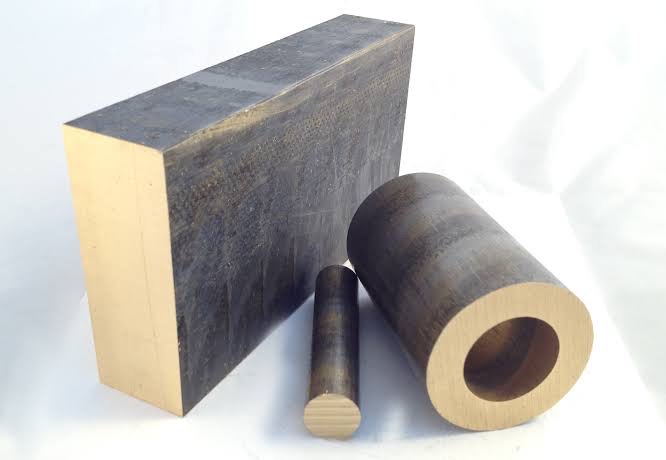
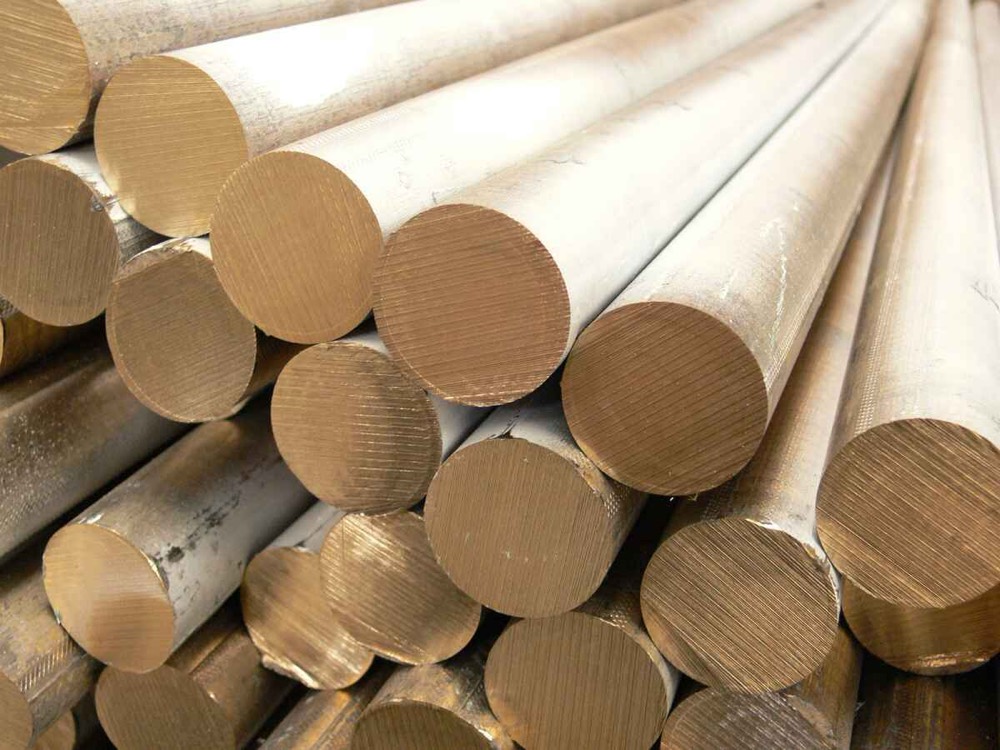
- Rod (round, hex, square)
- Sheet & strip
- Plate
- Tube
- Forgings
- Ingot
Applications & industries
- Precision-turned fittings and connectors
- Valve stems, seats and trim
- Gears, pinions and fasteners
- Formed hardware and radiator parts
- Shipboard fittings (naval brass)
Selection notes & limitations
- Leaded free-cutting grades may be restricted for drinking-water contact in some jurisdictions — state the end use.
- Cartridge brass and free-cutting brass are not interchangeable: one is optimised for forming, the other for machining.
What to specify when requesting a quote
- 1Whether the part is machined, formed or forged (drives grade choice)
- 2Any lead-content restriction for the end use
- 3Grade and the standard it must conform to (ASTM, EN, IS, UNS or your drawing)
- 4Form and dimensions — thickness or diameter, width, length and tolerances
- 5Approximate quantity, and whether the requirement is one-off or recurring
- 6Intended application, so the grade can be cross-checked before quoting
- 7Documents required — e.g. mill test certificate, chemical analysis, certificate of conformity
- 8Delivery city / site and the date you need material by
Documents buyers may request
Mill test certificate
e.g. EN 10204 type 3.1 inspection certificate, where the producing mill issues one
Chemical analysis report
heat / lot composition against the specified grade
Certificate of conformity
confirming the material meets the ordered standard
Heat / lot traceability
heat numbers marked on material and documents
Dimensional inspection report
for cut-to-size or machined material
Safety Data Sheet (SDS)
especially for lead, beryllium-, cadmium- or lead-bearing products
Which documents can be provided depends on the source mill and is confirmed with each quotation.
Frequently asked questions
Which brass machines best?
C36000 free-cutting brass is the reference alloy for copper-alloy machinability (rating 100). Its lead addition is what makes it free-cutting.
Which brass is used for marine fittings?
Naval brass (C46400) contains 0.5–1.0% tin and is listed for fresh- and salt-water service. For seawater piping, copper-nickel alloys are usually considered instead — ask us to compare.
Sources & technical references
- C36000 — Free-Cutting Brass (CDA alloy database) — Copper Development Association Inc. (CDA). Checked 2026-10-14.
- C26000 — Cartridge Brass, 70% (CDA alloy database) — Copper Development Association Inc. (CDA). Checked 2026-10-14.
- C46400 — Naval Brass, Uninhibited (CDA alloy database) — Copper Development Association Inc. (CDA). Checked 2026-10-14.